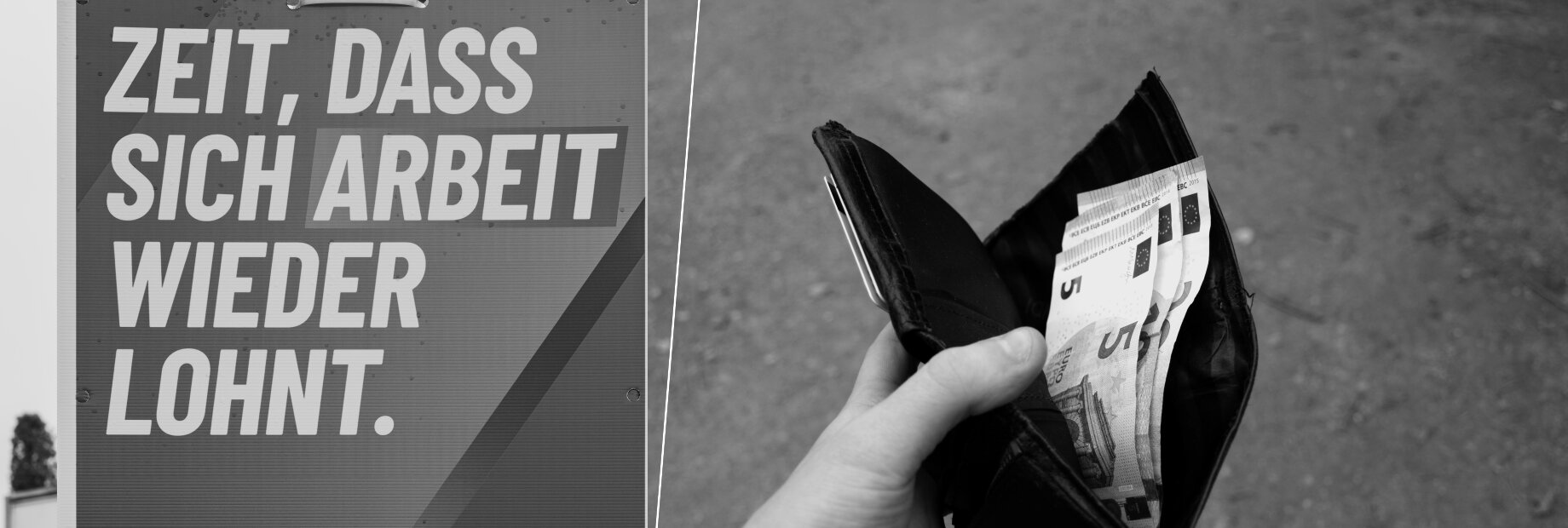
Right on the Money?
What income tells us about AfD support
Photos: PantheraLeo1359531 (CC BY 4.0), Santeri Viinamäki (CC BY-SA 4.0), edited


Support for the AfD is often linked to poverty and low incomes. Survey data from the 2025 federal election paint a different picture: AfD voting varies only weakly with household income.
In public debates, support for Germany’s far-right AfD is often traced back to poverty and low incomes. “We have long known that the AfD is particularly successful where people are poor and getting poorer,” reads a recent contribution in DIE ZEIT. In the same vein, a commentary in der Freitag argues that with rising poverty “the breeding ground for the far-right AfD is growing as well”. In a newspaper column the head of the German Institute for Economic Research (DIW) even speaks of an “AfD paradox”: low income voters would support a party whose supposedly market liberal policies would hit them hardest. But do voters with low incomes really vote AfD more often than others? Survey data from the last federal election suggest that income is a rather weak characteristic for explaining who votes AfD.
The data come from the post-election survey of the German Longitudinal Election Study (GLES) for the 2025 federal election, a large representative survey conducted shortly after the election (n = 5,321). Respondents were asked which party they voted for and how much net income their household has per month in total, after taxes and social security contributions, in brackets from “under €500” to “€10,000 and more”.1
1. AfD support barely changes with income
A first step is to look at the AfD’s share of the vote across income groups. Among respondents with a monthly net household income below €1,500, the AfD receives 17.4 percent of the vote. This share changes little across the lower and middle parts of the income distribution, forming a broad plateau of roughly 16 to 18 percent among households earning up to €5,000 per month. In fact, the AfD reaches its highest vote share not among the lowest-income households, but among those earning between €2,000 and €2,500, at 18.1 percent. Even among households with considerably higher incomes of €3,000 to €4,000 and €4,000 to €5,000, its vote share does not fall significantly but remains at 15.7 and 15.9 percent, respectively. Only beyond €5,000 does a pronounced decline emerge: AfD support falls to 10.2 percent among households earning between €5,000 and €7,500 and to just 6.6 percent among those earning €7,500 or more. The relationship between household income and AfD voting is therefore neither particularly strong across most of the income distribution nor linear. Rather than declining steadily as income rises, AfD support remains relatively constant across lower and middle income groups before dropping sharply among higher-income households. The roughly 11-percentage-point gap between the lowest and highest income groups thus seems to be driven primarily by the markedly lower support among affluent households, rather than by exceptionally high support among the poorest.
AfD vote share by household income, Federal Election 2025
This relatively flat pattern could, however, simply mask substantial regional differences, given that AfD support is considerably stronger in East Germany, where average incomes are also lower. Separating East and West Germany, however, shows very similar patterns across the income distribution, although at very different levels of support. In East Germany, the AfD receives between 22 and 29 percent of the vote across all income groups up to €5,000 per month, with its highest share among households earning less than €1,500. In West Germany, support is much lower but even more stable, remaining between 13 and 15 percent across the same income range. Only above €5,000 does AfD support decline markedly in both regions, falling to around 14 percent in the East and 6 percent in the West among households earning €7,500 or more. So while the overall level of AfD support differs widely between East and West Germany, the relationship between household income and AfD voting follows a broadly similar pattern in both regions.
AfD vote share by household income in East and West Germany, Federal Election 2025
2. Comparing like with like, the income gap shrinks further
Even this regional breakdown, however, says little about whether income itself is associated with AfD voting independently of other characteristics. People with different household incomes also differ in age, education, household size and where they live, all of which may be related to electoral preferences for the AfD. Household size is a particularly relevant confounder because the same household income can imply very different living standards: €3,000 a month provides substantially more resources for someone living alone than for a family of four. To account for these differences, we estimate a logistic regression model controlling for age, sex, education, household size and East/West Germany.
The regression results confirm the descriptive findings. In the bivariate model, which considers income alone, the predicted AfD vote share is 18.2 percent among households earning less than €1,500 per month, compared with 6.7 percent among those earning €7,500 or more, a gap of 11.5 percentage points. Once the controls are included, this gap narrows to around 7 percentage points, with predicted AfD support falling from approximately 17.3 to 10.3 percent. The relationship between income and AfD voting thus becomes even flatter, with a less pronounced decline in support as income rises. The overall pattern nevertheless remains broadly unchanged: across lower and middle income groups, predicted AfD support varies relatively little, while a clearer decline appears only among higher-income households.
Predicted AfD vote share by household income, without and with controls, Federal Election 2025
The remaining difference in AfD support between income groups appears to be driven mainly by households at the very top of the income distribution. To examine this more closely, we compare respondents with a monthly net household income below €2,000 directly with those in higher income groups. The results show that low income respondents are not significantly more likely to vote AfD than those in the next income group (€2,000 to €2,500), the median income group (€3,000 to €4,000), or the group just above the average household income (€4,000 to €5,000). This holds both before and after controlling for demographic and regional characteristics. A statistically significant difference emerges only when comparing low income households with the highest income group, earning €7,500 or more per month. While this gap amounts to approximately 11 percentage points without controls, it narrows to around 7 percentage points once the controls are included. The remaining income gap does not reflect disproportionate AfD support among low income households compared with those in the middle of the income distribution. Rather, it is again largely explained by the far lower support for the AfD among households with the highest incomes.
AfD vote: low earners (under €2,000) vs. higher income groups, Federal Election 2025
The finding that income is only weakly associated with AfD support is not unique to the 2025 election but consistent with a substantial body of existing research. Studies using German survey and panel data have found that objective deprivation, such as poverty or unemployment, is not strongly associated with support for the AfD (Lengfeld 2017; Schröder 2018). Similarly, lower income groups identify only slightly more frequently with the party, while individuals who have experienced growing material disadvantage in the form of an actual decline in income are no more likely to support it (Hartmann, Kurz and Lengfeld 2022). Indeed, shortly after the AfD was founded, its supporters had above average incomes, which subsequently converged towards the population average (Bergmann, Diermeier and Niehues 2017).
Where economic circumstances do matter, research suggests that perceptions of one’s social and economic position may be more important than objective deprivation or material disadvantage as such. Relevant factors include a low perceived social status (Gidron and Hall 2017), economic insecurity, fears of downward mobility, status anxiety and industrial decline, particularly within the lower middle class (Kurer 2020; Engler and Weisstanner 2021), and perceptions of being treated unfairly relative to others (Hövermann 2025). These studies suggest that support for the AfD is less closely linked to how much people actually earn than to how they perceive their position in society and their prospects for the future.
3. AfD voters come mostly from the lower and middle middle class
So far, the focus has been on the AfD alone. Whether its income profile is unusual becomes clearer when compared with other parties. Here, too, the AfD does not stand out for unusually strong support among low earners. Its vote share remains relatively stable across lower and middle income groups and declines only at higher incomes. By contrast, support for the CDU/CSU and the Greens varies much more strongly with income. The CDU/CSU’s vote share rises from around 22 percent in the lowest income group to 37 percent in the highest, while support for the Greens increases from roughly 10 to 27 percent. Both parties draw considerably more support from higher income households. The AfD’s income profile differs markedly from those of the CDU/CSU and the Greens, whose support shows a much clearer upward gradient with income.
Second vote by household income, Federal Election 2025
The same data can also be viewed from the opposite perspective: instead of asking how people in different income groups voted, we can examine how income is distributed among each party’s voters. From this angle, the AfD electorate is concentrated in the lower and middle parts of the income distribution. Around 47 percent of AfD voters live in households with a monthly net income below €3,000, while only about 15 percent live in households earning €5,000 or more. In this respect, the income profile of AfD voters closely resembles that of SPD, BSW and Left voters. The Greens and the FDP, on the other hand, have considerably more affluent electorates, with 37 and 38 percent of their voters, respectively, living in households earning at least €5,000 per month. The AfD electorate therefore does not have an unusual income composition.
Household income of each party's voters, Federal Election 2025
4. It is the Left, not the AfD, that draws on low incomes
But while the income composition of AfD voters resembles that of SPD, BSW and Left voters, this does not mean that income is equally important for support for these parties. A useful comparison is Die Linke (the Left), which appears to draw much more strongly on voters at the lower end of the income distribution. To examine this difference more closely, we again use logistic regression models that account for age, sex, education, household size and East/West Germany. Unlike the AfD, whose predicted vote share changes little across lower and middle income groups, support for Die Linke declines almost steadily as income rises. Among respondents with a monthly net household income below €1,500, Die Linke’s predicted vote share stands at around 16 percent, only slightly below that of the AfD. But while AfD support barely moves across the following income groups, support for Die Linke falls steadily, reaching around 10 percent among households earning €3,000 to €4,000 and just 4 percent among those earning €7,500 or more. Electoral support for Die Linke thus exhibits a much stronger income gradient than the AfD, with its support more clearly concentrated among lower income groups even after accounting for demographic and regional differences.
Predicted AfD and Left vote share by household income, Federal Election 2025
The direct comparisons between income groups further illustrate how differently income is associated with support for the major parties.3 Die Linke is the only party for which low earners are significantly more likely to vote than respondents in the middle and upper income groups. Compared with the next income group (€2,000 to €2,500), support for Die Linke among respondents with a monthly net household income below €2,000 is about 4 percentage points higher, although this difference is not yet statistically significant. It grows to around 6 to 7 percentage points relative to the median income group (€3,000 to €4,000) and the group just above the average household income (€4,000 to €5,000). Compared with the highest income group (€7,500 or more), the gap reaches approximately 12 percentage points. The CDU/CSU shows the opposite pattern: low earners are around 6 to 8 percentage points less likely to support it than respondents in the median and above average income groups, and almost 20 percentage points less likely than those in the highest income group. The Greens also receive significantly less support among low earners than among the highest income group, although the differences across the middle of the income distribution are less pronounced. Neither the SPD nor the BSW, however, shows statistically significant differences between low earners and any of the comparison groups. The AfD resembles these latter parties more closely: as shown above, a significant difference emerges only in comparison with the highest income group. Die Linke is thus the only party with consistently and significantly stronger support among low earners compared with the middle and upper income groups, while electoral support for the AfD exhibits a much weaker relationship with income.
Low earners (under €2,000) vs. higher income groups by party, Federal Election 2025
5. Education matters far more than income
If income is only weakly associated with AfD voting, which characteristics matter more? Among the socioeconomic characteristics examined here, formal education shows by far the strongest association. It is measured by respondents’ highest general school-leaving qualification, in five levels: no qualification, lower secondary (Hauptschule or Volksschule), intermediate secondary (Realschule or Mittlere Reife), advanced technical (Fachhochschulreife) and the Abitur.4 In Germany’s tracked school system, this qualification is a good measure of formal education: almost all adults have one, it is acquired early in life, and it largely determines access to vocational training and higher education, with the Abitur being the usual prerequisite for university. Unlike income, it also hardly changes over the life course, so it is not affected by temporary circumstances such as unemployment or retirement. It does not separately identify university graduates, but since almost all of them hold the Abitur or the Fachhochschulreife, they fall into the two highest categories. To compare the two directly, we estimate the relationship between education and income and AfD support within the same logistic regression model, controlling for age, sex, household size and region. The differences are large. Among respondents with no formal school qualification, the predicted AfD vote share reaches 36.7 percent, although this estimate is subject to considerable uncertainty. It falls to 24.1 percent among those with a lower secondary school qualification (Hauptschule), 19.2 percent among those with an intermediate secondary qualification (Realschule), and 11.5 percent among those with an advanced technical qualification (Fachhochschulreife). Among respondents with the Abitur, the predicted share is just 4.9 percent. The gap between those with a Hauptschule qualification and those with the Abitur alone amounts to roughly 19 percentage points. Across income groups, in contrast, predicted AfD support varies much less, remaining between approximately 14 and 18 percent for households earning up to €5,000 per month and declining to around 10 percent only in the highest income group. And while support for the AfD decreases consistently with each higher level of education, the relationship with income is much flatter and less systematic.
Predicted AfD vote share by education and household income, Federal Election 2025
This pattern fits a growing body of research that describes education as one of the central political divides in Western Europe. Over the past decades, voters with lower formal education have increasingly turned to the radical right, while the highly educated have moved towards green and left parties; income, meanwhile, continues to structure votes mainly along the traditional left-right divide (Gethin, Martínez-Toledano and Piketty 2022; Abou-Chadi and Hix 2021). The educational gap in radical right voting has widened from one generation to the next (Schäfer and Steiner 2025), and education is now regarded as a cleavage comparable to the classic divides of class and religion (Stubager 2010; Hooghe and Marks 2025). Education is thought to matter above all through values: higher education goes along with more libertarian and less authoritarian attitudes (Stubager 2008), and even the field of study helps to predict support for parties such as the AfD (Hooghe, Marks and Kamphorst 2024). Not all of this is necessarily an effect of schooling itself, however: panel data suggest that part of the link reflects who goes on to higher education in the first place (Lancee and Sarrasin 2015).
Conclusion
The findings confirm what research on the AfD has shown for years: the AfD is not primarily a party of low earners. Its support remains relatively stable across most of the income distribution and declines noticeably only among households with higher incomes. Unlike for Die Linke, low income is not associated with substantially greater support for the AfD once age, education and region are taken into account. Formal education is a far stronger predictor of AfD voting.
This does not mean, however, that economic concerns are irrelevant to AfD support. Research suggests instead that they matter less through objective deprivation and material disadvantage, such as poverty, low income or unemployment, than through how people perceive their own economic and social position. In the WSI employee panel, for example, AfD support varies only slightly between income groups. Among respondents who fear for their standard of living or feel disadvantaged compared with others, however, more than 30 percent vote for the AfD, regardless of whether their income is low, middle or high (Hövermann 2025). Comparative research points in a similar direction: perceived status loss and fears of social decline appear to matter more for support for the populist right than actual economic hardship, particularly among the lower middle class (Gidron and Hall 2017; Kurer 2020; Engler and Weisstanner 2021). Such perceptions are not necessarily limited to those who face material disadvantage. A recent study using SOEP data finds that people who underestimate their position in the income distribution tend to hold stronger populist attitudes, regardless of their actual income (Albers, Bischof, Kersting and Kosse 2026). This also helps explain why concerns about economic status may extend well beyond the poorest households.
Even this emphasis on subjective economic insecurity may, however, have its limits. Recent research suggests that perceived deprivation alone cannot adequately explain support for the AfD. Using SOEP data from 2014 to 2024, Martin Schröder and colleagues find that concerns about immigration account for roughly three quarters of the differences in AfD support that their model can explain, while income, education, life satisfaction, financial worries and fears of social decline contribute comparatively little (Schröder, Rehm and Röcke 2026; see also Lengfeld and Dilger 2018). To understand AfD support, it is therefore more useful to look at how people perceive their position in society and, above all, at their views on immigration than at their actual economic circumstances.
1 For the analysis, these brackets are grouped into eight income groups. Included are all respondents who report a party vote and their household income; the results are weighted to match the population.
2 The highest income group (€7,500 and more) comprises only 402 respondents, 67 of them in East Germany. Small differences between neighbouring income groups should not be over-interpreted.
3 All comparisons account for age, sex, education, household size and region (East/West).
4 The equivalent qualifications of the former GDR’s polytechnic and extended secondary schools are included in these categories, so respondents from East and West Germany can be compared directly.
Method. Data: GLES post-election survey 2025 (ZA10100). Base: respondents who report a second vote for a party and their household income (n = 5,321); non-voters are not included. All results are weighted. The models are logistic regressions with income (eight groups) and controls for age, sex, school education, household size and East/West (Berlin = West), all estimated on the same respondents (n = 5,248). Predicted shares are averages over all respondents.
Data: GLES (GESIS). Figures: Julius Kölzer.
References
- Abou-Chadi, T. & Hix, S. (2021). Brahmin Left versus Merchant Right? Education, class, multiparty competition, and redistribution in Western Europe. British Journal of Sociology, 72(1), 79–92.
- Albers, T. N. H., Bischof, D., Kersting, F. & Kosse, F. (2026). When the well-off feel left behind: income misperception and populist attitudes. SocArXiv, doi:10.31235/osf.io/2s7mc_v1.
- Bähr, S. (2025). Managergehälter steigen, Armut nimmt zu: Warum das ein perfekter Nährboden für die AfD ist. der Freitag, 9 May 2025.
- Bergmann, K., Diermeier, M. & Niehues, J. (2017). Die AfD: Eine Partei der sich ausgeliefert fühlenden Durchschnittsverdiener? Zeitschrift für Parlamentsfragen, 48(1), 57–75.
- Engler, S. & Weisstanner, D. (2021). The threat of social decline: income inequality and radical right support. Journal of European Public Policy, 28(2), 153–173.
- Fratzscher, M. (2026). Sachsen-Anhalt würde sich mit der AfD selbst am meisten schaden. Column “Fratzschers Verteilungsfragen”, ZEIT Online, 24 July 2026.
- Gethin, A., Martínez-Toledano, C. & Piketty, T. (2022). Brahmin Left versus Merchant Right: changing political cleavages in 21 Western democracies, 1948–2020. Quarterly Journal of Economics, 137(1), 1–48.
- Gidron, N. & Hall, P. A. (2017). The politics of social status: economic and cultural roots of the populist right. British Journal of Sociology, 68(S1), S57–S84.
- Hartmann, J., Kurz, K. & Lengfeld, H. (2022). Modernization losers’ revenge? Income mobility and support for right- and left-wing populist parties in Germany. European Sociological Review, 38(1), 138–152.
- Hooghe, L. & Marks, G. (2025). How does the education cleavage stack up against the classic cleavages of the past? West European Politics, 49(3), 636–668.
- Hooghe, L., Marks, G. & Kamphorst, J. (2024). Field of education and political behavior: predicting GAL/TAN voting. American Political Science Review, 119(2), 794–811.
- Hövermann, A. (2025). Die Verdopplung des AfD-Elektorats: Erkenntnisse aus dem WSI-Erwerbspersonenpanel 2020–2025. WSI Study 42. Düsseldorf: Hans-Böckler-Stiftung.
- İnan, Ö. (2026). Aufrüstung hilft nicht gegen Angst. DIE ZEIT, No. 24/2026.
- Kurer, T. (2020). The declining middle: occupational change, social status, and the populist right. Comparative Political Studies, 53(10–11), 1798–1835.
- Lancee, B. & Sarrasin, O. (2015). Educated preferences or selection effects? A longitudinal analysis of the impact of educational attainment on attitudes towards immigrants. European Sociological Review, 31(4), 490–501.
- Lengfeld, H. (2017). Die „Alternative für Deutschland“: eine Partei für Modernisierungsverlierer? Kölner Zeitschrift für Soziologie und Sozialpsychologie, 69(2), 209–232.
- Lengfeld, H. & Dilger, C. (2018). Kulturelle und ökonomische Bedrohung. Eine Analyse der Ursachen der Parteiidentifikation mit der „Alternative für Deutschland“ mit dem Sozio-oekonomischen Panel 2016. Zeitschrift für Soziologie, 47(3), 181–199.
- Schäfer, A. & Steiner, N. D. (2025). How education, generation and gender jointly structure green and radical right voting. West European Politics, 49(3), 669–696.
- Schröder, M. (2018). AfD-Unterstützer sind nicht abgehängt, sondern ausländerfeindlich. SOEPpapers 975. Berlin: DIW.
- Schröder, M., Rehm, M. & Röcke, A. (2026). Supporters of Germany’s far-right AfD party are concerned about immigration rather than feeling deprived. PLOS ONE, 21(7), e0350403.
- Stubager, R. (2008). Education effects on authoritarian–libertarian values: a question of socialization. British Journal of Sociology, 59(2), 327–350.
- Stubager, R. (2010). The development of the education cleavage: Denmark as a critical case. West European Politics, 33(3), 505–533.